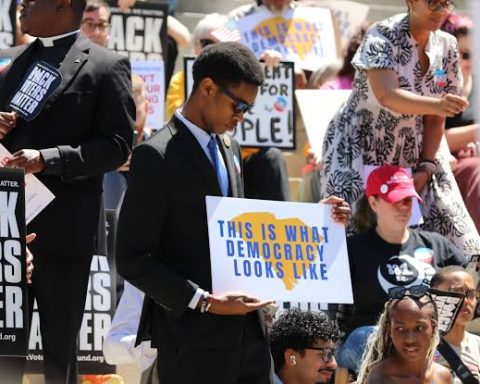
Black voters in South Carolina should not treat politics like a football game.
This is not Clemson versus Carolina. This is not about cheering for a team no matter what happens on the field. Politics is not blind loyalty. Politics is about power, priorities, and choices. It is about making sure your community, your businesses, your schools, your hospitals, and your future receive fair access to resources.
That is the lens we should use when looking at every candidate for governor, including Billy Webster.
Recently, Webster agreed to sit down with me and several other Black media outlets. No question was off the table. He made it clear we could ask him anything, on any subject, and he would answer on the record.
That deserves credit.
In politics, especially in South Carolina, many candidates want Black votes but avoid Black media because Black media asks specific questions. We do not just ask what you will do for “working families.” We ask what you will do for Black communities. That specificity creates accountability.
Webster stepped into that space willingly. He did not dodge. He did not get defensive. He answered the questions. He made his case.

That speaks to a level of character and courage that Black voters should at least consider.
Webster is running as a businessman and problem solver. That is his lane. He has built businesses, worked in the Clinton White House, and served with former South Carolina Governor Dick Riley at the U.S. Department of Education. The Clinton Presidential Library notes that Webster worked with Riley during the Clinton transition, served as Riley’s chief of staff at the Department of Education, and later became Director of Scheduling and Advance in the Clinton White House.
That experience should not be ignored. It should be examined.
A person who has worked in business understands negotiation. A person who has worked in government understands how systems move. A person who has worked across political environments may have a better chance of getting people to the table in a state where Democrats cannot pass major legislation alone.
That does not mean one interview settles everything.
It means it should start a more serious conversation.
What I Took Away From the Interview
The biggest thing I walked away with is this: Billy Webster understands how to solve problems through negotiation.
That matters because South Carolina has problems that will not be solved by speeches. Medicaid expansion will require deal-making. Infrastructure will require coalition-building. Minority business access, rural hospitals, education, affordable housing, fair lending, and economic development will all require someone who understands how to move people, policy, and resources.
When asked what his “Don’t talk, just do” message would mean for Black, Latino, rural, and working-class communities, Webster said his first-week priority would be starting the process to expand Medicaid in South Carolina. He connected health care to work, education, rural hospitals, medical debt, veterans, and job creation.
That was a serious answer.
He also spoke about economic development like someone who understands deal-making. On major projects, he argued South Carolina must secure community benefits on the front end, not after the deal is already done. He said counties should receive benefits tied to education, affordable housing, infrastructure, and conservation.
That matters.
Black communities have watched too many economic development deals create headlines for politicians and profits for corporations while local communities are left with bad roads, weak schools, limited housing, poor health care access, and lack of capital.
Webster’s argument is that South Carolina needs better deals.
Black communities need better deals too.
A Hard Question He Answered Directly
Advance America is part of Webster’s record, and it came up in the interview. But it should not be the only lens through which he is viewed.
Webster said he entered the short-term credit industry because a real need existed. His argument was that working families needed access to small-dollar credit, and the banking industry was not providing it. He said customers had to have a job and a bank account, and he distinguished Advance America from check cashing and title lending.
That point matters.
The credit system in America does not work equally for everyone. It works best for the wealthy, the connected, and those who already have access. For many Black, rural, and working-class families, banks have historically failed to provide fair access to credit.
Webster also said the industry today is not the same industry he entered in 1997. He said he supported regulation, including a database system designed to prevent borrowers from taking out multiple payday advances at different stores before paying one back. He also acknowledged that the broader consumer finance system needs to be rethought and reimagined.
That is where the conversation should be.
Not simply what he built then.
What will he reform now?
This Is Our Time to Weigh Our Choices
In a recent article, I wrote about Senator Shane Massey saying what too many Democrats will not say plainly: Black voters matter. During the redistricting fight, Massey warned that pushing the Trump-backed redistricting effort could have intended and unintended consequences for Republicans up and down the ballot by motivating Black voters.
The point was clear: Republicans fear Black turnout because Black turnout can change elections.
That should remind us of what we should have already known.
Our votes matter.
Our turnout matters.
Our power is valued.
Now the question is whether we are willing to use that power strategically.
There are several Democratic candidates running for governor. Webster is one of them. Every candidate should be questioned. Every candidate should be challenged. Every candidate should be evaluated based on what they are offering Black communities.
We cannot sit back and be told what we are going to get.
We have to ask for what we want.
We need to weigh each candidate’s plans for Medicaid expansion, Black-owned businesses, minority access to state contracts, rural hospitals, public education, fair lending, Black media, Black farmers, Black contractors, and Black communities that have been left out of South Carolina’s growth.
Billy Webster made his case.
Every other candidate should be required to do the same.
Because this election is not about cheering for a team.
It is about weighing our choices, using our power wisely, and choosing the candidate best prepared to fight for a South Carolina where every community has a brighter future.